
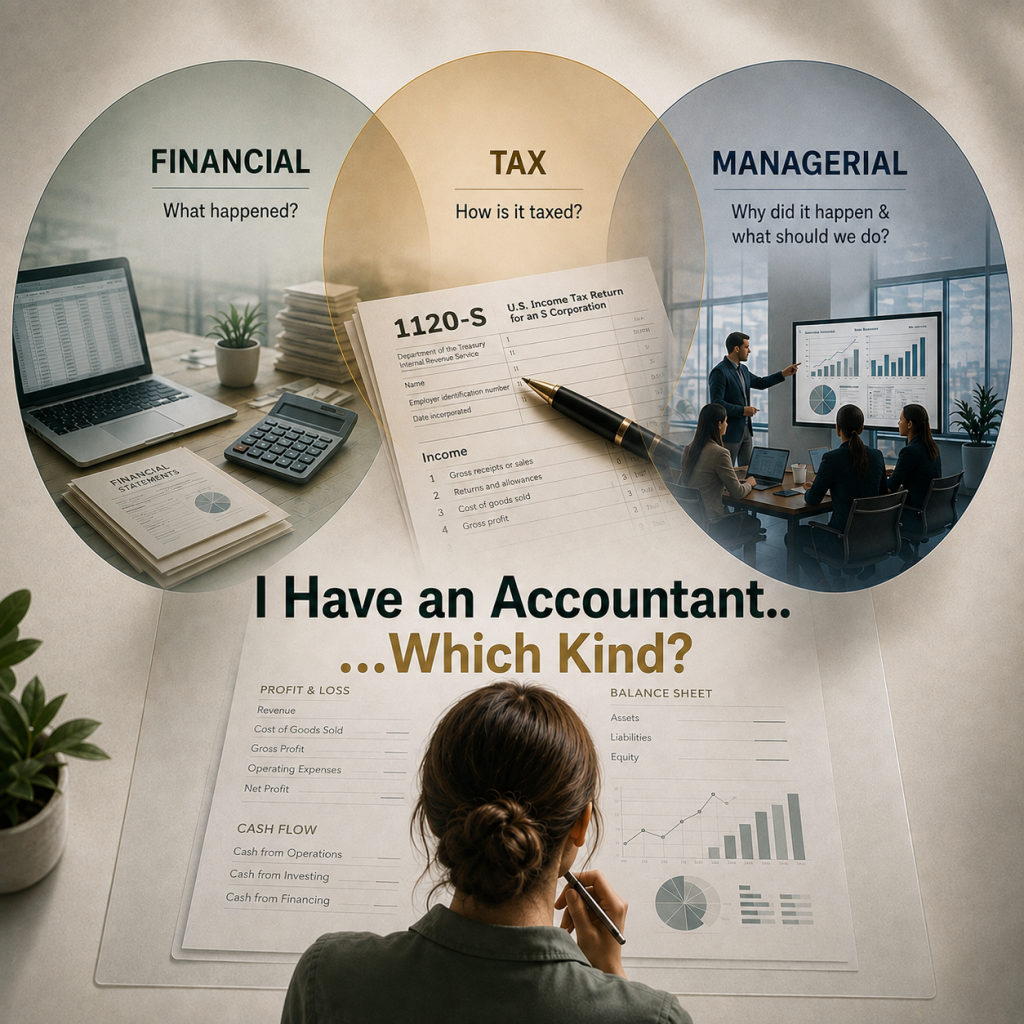
…What Kind?
“I have an accountant.”
I hear that all the time.
Whenever someone says it, I almost always ask the same follow-up question:
“Tell me about them.”
Not because I’m trying to be difficult.
Because after years of working with business owners, I’ve learned those four words can mean wildly different things.
Sometimes they mean:
“I have a bookkeeper.”
Sometimes:
“My CPA does my taxes.”
Sometimes:
“We hired a fractional CFO.”
None of those answers are wrong.
But they don’t actually answer my question.
Because the real question isn’t whether you have an accountant.
It’s whether you’re getting what your business actually needs—not just what the title implies.
If you’ve ever looked at your financial statements and thought, “I still don’t know what they’re trying to tell me,” you’re not alone.
Accounting Isn’t One Thing
One reason business owners get frustrated is because we’ve collapsed an entire profession into a single word:
Accounting.
As if it’s one service.
It isn’t.
It’s made up of different disciplines, each with a different purpose.
The confusion begins when we expect one discipline to deliver what another was designed to provide.
Financial Accounting: The Foundation
Financial accounting answers one simple question:
What actually happened?
This is where bookkeeping lives.
Its purpose isn’t data entry.
It’s creating financial statements that accurately reflect the economic reality of your business.
Every invoice.
Every bill.
Every payroll run.
Every balance sheet account.
Together, they tell the financial story of your business.
Or at least they’re supposed to.
Because if the accounting isn’t accurate, everything built on top of it becomes less reliable.
As I often say:
No good decision comes from bad data.
Tax Accounting: Applying the Rules
Tax accounting answers a different question:
How does the tax code treat what happened?
Your CPA isn’t recreating your accounting records.
They’re relying on them.
If the accounting doesn’t accurately reflect the business, there can be real tax implications—not because your CPA isn’t doing their job, but because they’re working from information that doesn’t tell the complete story.
This becomes especially important if your business is an LLC taxed as an S Corporation.
Many owners focus almost exclusively on the Profit & Loss.
I get it—that’s where revenue and expenses live.
But your Balance Sheet matters just as much because key parts of it flow directly into your S Corporation tax return.
Shareholder basis.
Loans.
Distributions.
Equity.
Retained earnings.
Those aren’t simply tax concepts.
They’re accounting concepts.
If the accounting isn’t right, the tax return may not be telling the complete truth about the business either.
Managerial Accounting: Understanding the Business
The third discipline is one many business owners have never heard of—even though they’ve probably had it provided by someone before.
It’s called managerial accounting.
Depending on the needs of the business, it may be provided by a strategic advisor, a controller, a CFO, or a fractional CFO.
When it isn’t, the business owner often ends up trying to figure it out themselves.
Financial accounting tells you what happened.
Managerial accounting helps you understand why it happened.
It asks questions like:
- What does this financial information tell us about how the business is performing?
- Why did gross margin decline even though sales increased?
- Can we afford another employee?
- Are our prices keeping up with rising costs?
- Is cash flow tightening because sales slowed, because customers are paying more slowly, or because we’re investing in future growth?
- Which parts of the business create value, and which quietly drain resources?
These aren’t bookkeeping questions.
They aren’t tax questions.
They’re business questions.
Managerial accounting connects financial information to the day-to-day realities of running the business, creating the understanding that helps owners make more informed decisions.
So Why Does It Still Feel Like Something’s Missing?
This is the question I hear most often.
Not literally.
But underneath the conversation.
Business owners have a bookkeeper.
They have a CPA.
Sometimes they even have a strategic advisor or fractional CFO.
Yet they still feel like they’re making important decisions with only part of the picture.
Why?
Because financial statements tell only one version of the story.
They tell you what happened financially.
They don’t tell you what happened operationally.
Only you know that.
You’re the one who knows…
…why margins dropped.
…why payroll increased.
…why revenue slowed.
…why you hired before sales caught up.
…why a large customer left.
…why your team spent three weeks solving a customer problem that never appears as a line item on your financial statements.
The accounting system records the financial impact.
You know what actually happened in the business.
Financial statements are derived from the business.
Without connecting those two realities, your financial statements become…
Static information.
Useful?
Absolutely.
Complete?
Not even close.
What Business Owners Actually Need
Most business owners don’t need another report.
They don’t need another dashboard.
And they definitely don’t need someone reading their financial statements back to them like a weather report.
They need someone willing to ask better questions.
- Do these numbers accurately reflect what’s happening in the business?
- If not, why not?
- What changed this month?
- What decisions led to these results?
- Is this a one-time event or the beginning of a trend?
- Is the story your financial statements are telling consistent with the story you’re living every day?
Those conversations create something no report ever will:
Understanding.
And understanding leads to better decisions.
The Better Question
Business owners often ask:
“Do I need a bookkeeper?”
“Do I need a CPA?”
“Should I hire a fractional CFO?”
Those are all reasonable questions.
But I don’t think they’re the first ones.
The better question is this:
Who is helping me connect what actually happened in my business with what my financial information is telling me?
Because financial statements are derived from the business.
Understanding comes from connecting the two.
And that connection is the part most business owners are missing—until someone helps them make it.